
Uncategorized
Most No KYC Casinos Aren’t as Private as You Think

You sign up, deposit, play, win big – then the casino freezes your withdrawal and asks for a passport scan. It happens more often than most players expect. A true no kyc casino should let you deposit, play, and cash out without ever handing over identity documents. But here is the catch: “no KYC” almost never means “never.” Most sites that advertise no verification at sign-up quietly reserve the right to demand ID later – when you hit a withdrawal threshold, trigger an anti-money laundering flag, or simply win enough to get noticed.
What “No KYC” Actually Means
KYC stands for Know Your Customer – the standard identity check that fiat casinos and banks require. A no KYC casino skips that at registration. You give an email, choose a username, and start playing. But the fine print often says verification may be required later. Common triggers include large withdrawals, mismatched payment details, bonus abuse suspicion, or logging in from a restricted country. Some sites even conduct random audits. So a no-KYC policy is more of a delay than a permanent exemption. You need to know exactly where the line sits before you deposit.
No KYC vs. Anonymous: The Big Difference

People use these terms interchangeably, but they are not the same thing. No KYC is about paperwork – or the lack of it. Anonymity is a wider concept. It depends on several layers working together:
- Paying with crypto rather than a bank card removes the direct link to your identity.
- Using a privacy coin like Monero or Zcash hides transaction amounts and addresses.
- A non-custodial wallet keeps your funds off a KYC-verified exchange account.
- A VPN masks your IP address and physical location.
- A burner email and no linked social accounts keep your casino profile detached from your real identity.
A casino can be no KYC but still leak your privacy. Deposit Bitcoin bought from a verified exchange while connected over your home IP, and your activity is traceable despite no ID check. The most private setup combines a no-KYC site with every tool above.
How to Pick a No KYC Casino That Won’t Screw You
Because many no-KYC casinos are lightly regulated or unlicensed, reputation matters more than a fancy homepage. Check withdrawal policies before you sign up – look for clear thresholds where KYC kicks in. Test a small withdrawal early to see if it goes through smoothly. Also scan for red flags: unexplained pending withdrawals, vague support responses, or requests for fees before payouts. Legitimate casinos never ask for an extra “release fee” to hand over your winnings.
Game variety, payout speed, and bonus terms still count. Favour casinos with provably fair games and fast automated payouts. Avoid sites that hide their wagering requirements in footnotes. And if a welcome bonus seems too generous, read the fine print on withdrawal limits – predatory terms often lurk behind big numbers.
Maximise Your Privacy in Three Steps
To get as close to true anonymity as possible, do this:
- Use a non-custodial wallet like MetaMask or a hardware wallet. Never keep crypto on an exchange.
- Buy privacy coins through a decentralized exchange – avoid any platform that asks for ID.
- Always connect via a premium VPN, not a free one. Free VPNs often leak data and sell your traffic.
Keep transactions small and consistent. Big, irregular deposits or withdrawals draw attention – even at a no-KYC site.
The Bottom Line
No KYC casinos offer real privacy advantages over traditional sites, but they are not a magic cloak. Most will verify you eventually if you win big or behave suspiciously. The smart play is to choose a site with a genuine no-verification track record, combine it with privacy tools, and treat any bonus offer with skepticism. Responsible gambling also applies – crypto moves fast, and it is easy to lose track. Set limits, stay disciplined, and never gamble money you cannot afford to lose. In a market built on trust and code, a little caution goes a long way.



Prophet Israel Oladele of the Celestial Church of Christ, Genesis Global International Parish, has unveiled plans for the Luli Prayer Conference 2026, calling on members of the Celestial Church of Christ worldwide to embrace peace, unity and fervent prayers for Nigeria.
The Global Prophet made the announcement during a media briefing in Lagos, where he highlighted the spiritual significance of September 29, the founding day of the Celestial Church of Christ worldwide, describing it as a moment for thanksgiving, renewal and collective intercession.
According to him, this year’s conference will hold on September 29, 2026, at Genesis Global City, Alakuko, Lagos, bringing together Celestials, Christians and people of other faiths for a day of worship and prayer.
Prophet Oladele said the 2026 edition would place particular emphasis on praying for Nigeria as the country approaches another election cycle.
He noted that the church has a divine responsibility to continually seek God’s intervention for the nation’s peace, stability and progress, adding that the conference would extend beyond celebration to become a platform for prayers for Nigeria and the world.
“The Luli Prayer Conference is not just a celebration; it is a divine gathering where we unite in thanksgiving and seek God’s intervention for our nation and humanity,” he said.
The cleric also made a passionate appeal for unity within the Celestial Church of Christ, urging members across different parishes and regions to recognise their shared spiritual heritage.
He stressed that all Celestials are bound together by the legacy of the church’s founder, Reverend Samuel Bilewu Joseph Oshofa, whose vision continues to define the identity of the worldwide church.
According to Prophet Oladele, differences among members should never overshadow the common foundation laid by the founder, as unity remains essential to preserving the church’s mission.
He described Reverend Oshofa’s legacy as a rallying point capable of bringing together Celestials across the globe, regardless of branch, location or personal differences.
Looking ahead, the Global Prophet announced that the 2027 Luli Prayer Conference would coincide with the 80th anniversary of the Celestial Church of Christ, promising what he described as an “explosive” global celebration.
He said preparations for the landmark anniversary would begin immediately after this year’s conference, with activities expected to unite Celestials from around the world in celebrating eight decades of the church’s existence.
Prophet Oladele reiterated that preserving the unity of the Celestial family remains vital to honouring the vision of Reverend S.B.J. Oshofa and ensuring the continued growth of the church worldwide.
He concluded the briefing by urging members to embrace their shared identity, work together in love and continue praying for the peace and prosperity of Nigeria.
Uncategorized
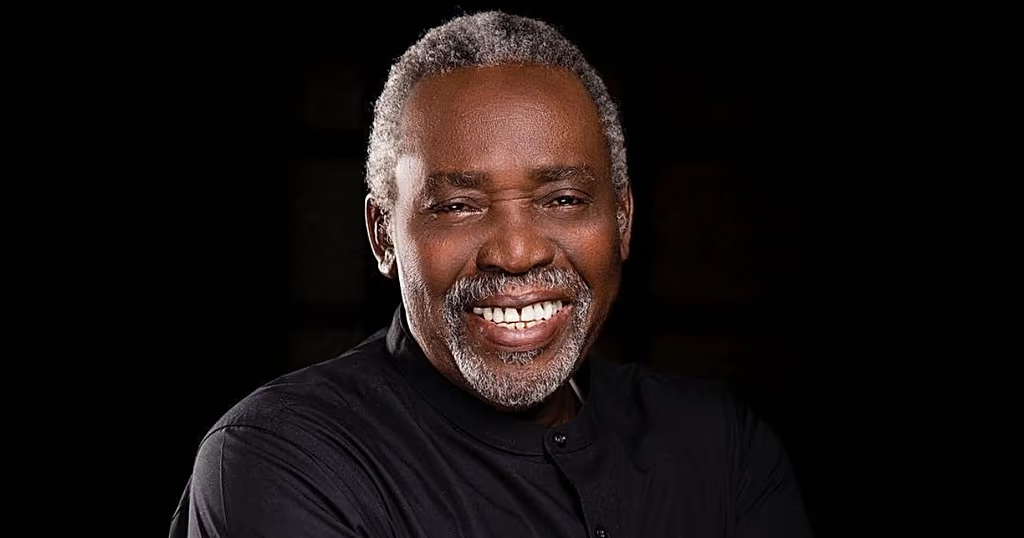
Africa Magic Mourns Late Olu Jacobs at 84, Revives His Stirring Message to Young Nollywood Hopefuls


Ajax striker Kasper Dolberg has praised Nigerian forward Tolu Arokodare’s goal-scoring instinct, describing his teammate as a specialist in positioning and a “monster in front of goal.”
Arokodare has made an impressive start to life at the Amsterdam club since joining on loan from Wolverhampton Wanderers, scoring five goals in eight appearances across competitions. The 25-year-old’s loan deal runs until the summer of 2027 and includes an option for Ajax to make the move permanent.
Dolberg, who is competing with Arokodare for a starting place, said he had been paying attention to the Nigerian’s movement inside the penalty area and believes there are aspects of his game that he can adopt.
“I enjoy participating in the game, but the coach wants me to be more aggressive in front of goal. And I understand that. In that regard, I can learn something from Tolu, even though he is a competitor,” Dolberg said.
The Danish striker went further in his assessment of Arokodare, highlighting the Nigerian’s ability to find the right positions and finish chances.
“He is a specialist in choosing his position and is a monster in front of goal. I talk to him a lot about that. I need to start scoring more,” Dolberg added.
Arokodare’s form has made him one of Ajax’s most productive attackers early in the 2026/27 campaign. His five goals have come in eight appearances, with two assists also recorded during the opening weeks of his spell in Amsterdam.
The Nigerian has also made an impact in European competition, scoring twice in Ajax’s 5-3 victory over Sion in the Conference League qualifying play-off. He subsequently scored in the club’s 4-0 league victory over Telstar.
His performances have also attracted praise from former Ajax midfielder Marciano Vink, who described the forward as a player with considerable footballing quality after watching his early performances for the club.
Arokodare joined Ajax during the summer from Wolverhampton Wanderers on a season-long loan, with the Dutch club holding an option to sign him permanently. Ajax’s official profile lists him as a Nigerian attacker and confirms his loan arrangement with Wolves.
For Dolberg, however, Arokodare’s influence extends beyond the competition for playing time. The Dane’s comments suggest that the Nigerian’s movement and efficiency inside the box are qualities he believes can help him improve his own scoring output.
The praise comes as Arokodare continues to establish himself at Ajax, with his early goalscoring form giving the Super Eagles another attacking option ahead of Nigeria’s 2027 Africa Cup of Nations qualifying campaign.


Uzor Arukwe Reveals Why He Is Not a Marriage Advocate

Bisola Aiyeola Says Marriage Is Not Her Life’s Priority

Iyabo Ojo Takes Legal Action Against Lizzy Anjorin


-

 Celebrity news4 weeks ago
Adunni Ade Says Christian Fans Unfollowed Over Faith
-

 Nollywood3 weeks ago
Ikenga Becomes Highest-Grossing Igbo Film at ₦103.4m
-

 Nollywood4 weeks ago
Funke Akindele Misses Kamo Premiere While on Ghana Staycation
-

 celebrities3 weeks ago
Toyin Abraham Gives Fans Cash, Gifts at Praise Concert
-
 Uncategorized4 weeks ago
Africa Magic Mourns Late Olu Jacobs at 84, Revives His Stirring Message to Young Nollywood Hopefuls
-

 Celebrity news3 weeks ago
‘Nigerians Annoyed Me’: Why Akintola Backed Tinubu
-

 Sports / Football4 weeks ago
Osimhen Makes Eagles Squad Despite Injury
-
 Celebrity news3 weeks ago
US Mission Pays Tribute to Late Actor Olu Jacobs